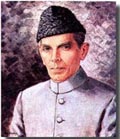
| Father of the Nation Quaid-i-Azam Muhammad
Ali Jinnah's
achievement
as the founder of Pakistan, dominates everything else he did in his
long and crowded public life spanning some 42 years. Yet, by any
standard, his was an eventful life, his personality multidimensional
and his achievements in other fields were many, if not equally
great. Indeed, several were the roles he had played with
distinction: at one time or another, he was one of the greatest
legal luminaries India had produced during the first half of the
century, an `ambassador of Hindu-Muslim unity, a great
constitutionalist, a distinguished parliamentarian, a top-notch
politician, an indefatigable freedom-fighter, a dynamic Muslim
leader, a political strategist and, above all one of the great
nation-builders of modern times. What, however, makes him so
remarkable is the fact that while similar other leaders assumed the
leadership of traditionally well-defined nations and espoused their
cause, or led them to freedom, he created a nation out of an
inchoate and down-trodden minority and established a cultural and
national home for it. And all that within a decade. For over three
decades before the successful culmination in 1947, of the Muslim
struggle for freedom in the South-Asian subcontinent, Jinnah had
provided political leadership to the Indian Muslims: initially as
one of the leaders, but later, since 1947, as the only prominent
leader- the Quaid-i-Azam. For over thirty years, he had guided their
affairs; he had given expression, coherence and direction to their
legitimate aspirations and cherished dreams; he had formulated these
into concrete demands; and, above all, he had striven all the while
to get them conceded by both the ruling British and the numerous
Hindus the dominant segment of India's population. And for over
thirty years he had fought, relentlessly and inexorably, for the
inherent rights of the Muslims for an honourable existence in the
subcontinent. Indeed, his life story constitutes, as it were, the
story of the rebirth of the Muslims of the subcontinent and their
spectacular rise to nationhood, phoenixlike.
Early
Life
Born on December 25,
1876, in a prominent mercantile family in Karachi and educated at
the Sindh Madrassat-ul-Islam and the Christian Mission School at his
birth place,Jinnah joined the Lincoln's Inn in 1893 to become the
youngest Indian to be called to the Bar, three years later. Starting
out in the legal profession with nothing to fall back upon except
his native ability and determination, young Jinnah rose to
prominence and became Bombay's most successful lawyer, as few did,
within a few years. Once he was firmly established in the legal
profession, Jinnah formally entered politics in 1905 from the
platform of the Indian National Congress. He went to England in that
year alongwith Gopal Krishna Gokhale (1866-1915), as a member of a
Congress delegation to plead the cause of Indian self-government
during the British elections. A year later, he served as Secretary
to Dadabhai Noaroji(1825-1917), the then Indian National Congress
President, which was considered a great honour for a budding
politician. Here, at the Calcutta Congress session (December 1906),
he also made his first political speech in support of the resolution
on self-government.
Political
Career
Three years later, in
January 1910, Jinnah was elected to the newly-constituted Imperial
Legislative Council. All through his parliamentary career, which
spanned some four decades, he was probably the most powerful voice
in the cause of Indian freedom and Indian rights. Jinnah, who was
also the first Indian to pilot a private member's Bill through the
Council, soon became a leader of a group inside the legislature. Mr.
Montagu (1879-1924), Secretary of State for India, at the close of
the First World War, considered Jinnah "perfect mannered,
impressive-looking, armed to the teeth with dialectics..."Jinnah, he
felt, "is a very clever man, and it is, of course, an outrage that
such a man should have no chance of running the affairs of his own
country."
For about three decades
since his entry into politics in 1906, Jinnah passionately believed
in and assiduously worked for Hindu-Muslim unity. Gokhale, the
foremost Hindu leader before Gandhi, had once said of him, "He has
the true stuff in him and that freedom from all sectarian prejudice
which will make him the best ambassador of Hindu-Muslim Unity: And,
to be sure, he did become the architect of Hindu-Muslim Unity: he
was responsible for the Congress-League Pact of 1916, known
popularly as Lucknow Pact- the only pact ever signed between the two
political organisations, the Congress and the All-India Muslim
League, representing, as they did, the two major communities in the
subcontinent.
The Congress-League
scheme embodied in this pact was to become the basis for the
Montagu-Chemlsford Reforms, also known as the Act of 1919. In
retrospect, the Lucknow Pact represented a milestone in the
evolution of Indian politics. For one thing, it conceded Muslims the
right to separate electorate, reservation of seats in the
legislatures and weightage in representation both at the Centre and
the minority provinces. Thus, their retention was ensured in the
next phase of reforms. For another, it represented a tacit
recognition of the All-India Muslim League as the representative
organisation of the Muslims, thus strengthening the trend towards
Muslim individuality in Indian politics. And to Jinnah goes the
credit for all this. Thus, by 1917, Jinnah came to be recognised
among both Hindus and Muslims as one of India's most outstanding
political leaders. Not only was he prominent in the Congress and the
Imperial Legislative Council, he was also the President of the
All-India Muslim and that of the Bombay Branch of the Home Rule
League. More important, because of his key-role in the
Congress-League entente at Lucknow, he was hailed as the ambassador,
as well as the embodiment, of Hindu-Muslim unity.
Constitutional
Struggle
In subsequent years,
however, he felt dismayed at the injection of violence into
politics. Since Jinnah stood for "ordered progress", moderation,
gradualism and constitutionalism, he felt that political terrorism
was not the pathway to national liberation but, the dark alley to
disaster and destruction. Hence, the constitutionalist Jinnah could
not possibly, countenance Mohandas Karamchand Gandhi's novel methods
of Satyagrah (civil disobedience) and the triple boycott of
government-aided schools and colleges, courts and councils and
British textiles. Earlier, in October 1920, when Gandhi, having been
elected President of the Home Rule League, sought to change its
constitution as well as its nomenclature, Jinnah had resigned from
the Home Rule League, saying: "Your extreme programme has for the
moment struck the imagination mostly of the inexperienced youth and
the ignorant and the illiterate. All this means disorganisation and
chaos". Jinnah did not believe that ends justified the means.
In the ever-growing
frustration among the masses caused by colonial rule, there was
ample cause for extremism. But, Gandhi's doctrine of
non-cooperation, Jinnah felt, even as Rabindranath Tagore(1861-1941)
did also feel, was at best one of negation and despair: it might
lead to the building up of resentment, but nothing constructive.
Hence, he opposed tooth and nail the tactics adopted by Gandhi to
exploit the Khilafat and wrongful tactics in the Punjab in the early
twenties. On the eve of its adoption of the Gandhian programme,
Jinnah warned the Nagpur Congress Session (1920): "you are making a
declaration (of Swaraj within a year) and committing the Indian
National Congress to a programme, which you will not be able to
carry out". He felt that there was no short-cut to independence and
that Gandhi's extra-constitutional methods could only lead to
political terrorism, lawlessness and chaos, without bringing India
nearer to the threshold of freedom.
The future course of
events was not only to confirm Jinnah's worst fears, but also to
prove him right. Although Jinnah left the Congress soon thereafter,
he continued his efforts towards bringing about a Hindu-Muslim
entente, which he rightly considered "the most vital condition of
Swaraj". However, because of the deep distrust between the two
communities as evidenced by the country-wide communal riots, and
because the Hindus failed to meet the genuine demands of the
Muslims, his efforts came to naught. One such effort was the
formulation of the Delhi Muslim Proposals in March, 1927. In order
to bridge Hindu-Muslim differences on the constitutional plan, these
proposals even waived the Muslim right to separate electorate, the
most basic Muslim demand since 1906, which though recognised by the
congress in the Lucknow Pact, had again become a source of friction
between the two communities. surprisingly though, the Nehru Report
(1928), which represented the Congress-sponsored proposals for the
future constitution of India, negated the minimum Muslim demands
embodied in the Delhi Muslim Proposals.
In vain did Jinnah argue
at the National convention (1928): "What we want is that Hindus and
Mussalmans should march together until our object is
achieved...These two communities have got to be reconciled and
united and made to feel that their interests are common". The
Convention's blank refusal to accept Muslim demands represented the
most devastating setback to Jinnah's life-long efforts to bring
about Hindu-Muslim unity, it meant "the last straw" for the Muslims,
and "the parting of the ways" for him, as he confessed to a Parsee
friend at that time. Jinnah's disillusionment at the course of
politics in the subcontinent prompted him to migrate and settle down
in London in the early thirties. He was, however, to return to India
in 1934, at the pleadings of his co-religionists, and assume their
leadership. But, the Muslims presented a sad spectacle at that time.
They were a mass of disgruntled and demoralised men and women,
politically disorganised and destitute of a clear-cut political
programme.
Muslim League
Reorganised
Thus, the task that
awaited Jinnah was anything but easy. The Muslim League was dormant:
primary branches it had none; even its provincial organisations
were, for the most part, ineffective and only nominally under the
control of the central organisation. Nor did the central body have
any coherent policy of its own till the Bombay session (1936), which
Jinnah organised. To make matters worse, the provincial scene
presented a sort of a jigsaw puzzle: in the Punjab, Bengal, Sindh,
the North West Frontier, Assam, Bihar and the United Provinces,
various Muslim leaders had set up their own provincial parties to
serve their personal ends. Extremely frustrating as the situation
was, the only consolation Jinnah had at this juncture was in Allama
Iqbal(1877-1938), the poet-philosopher, who stood steadfast by him
and helped to charter the course of Indian politics from behind the
scene.
Undismayed by this bleak
situation, Jinnah devoted himself with singleness of purpose to
organising the Muslims on one platform. He embarked upon
country-wide tours. He pleaded with provincial Muslim leaders to
sink their differences and make common cause with the League. He
exhorted the Muslim masses to organise themselves and join the
League. He gave coherence and direction to Muslim sentiments on the
Government of India Act, 1935. He advocated that the Federal Scheme
should be scrapped as it was subversive of India's cherished goal of
complete responsible Government, while the provincial scheme, which
conceded provincial autonomy for the first time, should be worked
for what it was worth, despite its certain objectionable features.
He also formulated a viable League manifesto for the election
scheduled for early 1937. He was, it seemed, struggling against time
to make Muslim India a power to be reckoned with.
Despite all the manifold
odds stacked against it, the Muslim Leauge won some 108 (about 23
per cent) seats out of a total of 485 Muslim seats in the various
legislature. Though not very impressive in itself, the League's
partial success assumed added significance in view of the fact that
the League won the largest number of Muslim seats and that it was
the only all-India party of the Muslims in the country. Thus, the
elections represented the first milestone on the long road to
putting Muslim India on the map of the subcontinent. Congress in
Power With the year 1937 opened the most momentous decade in modern
Indian history. In that year came into force the provincial part of
the Government of India Act, 1935, granting autonomy to Indians for
the first time, in the provinces.
The Congress, having
become the dominant party in Indian politics, came to power in seven
provinces exclusively, spurning the League's offer of cooperation,
turning its back finally on the coalition idea and excluding Muslims
as a political entity from the portals of power. In that year, also,
the Muslim League, under Jinnah's dynamic leadership, was
reorganised de novo, transformed into a mass organisation, and made
the spokesman of Indian Muslims as never before. Above all, in that
momentous year were initiated certain trends in Indian politics, the
crystallisation of which in subsequent years made the partition of
the subcontinent inevitable. The practical manifestation of the
policy of the Congress which took office in July, 1937, in seven out
of eleven provinces, convinced Muslims that, in the Congress scheme
of things, they could live only on sufferance of Hindus and as
"second class" citizens. The Congress provincial governments, it may
be remembered, had embarked upon a policy and launched a programme
in which Muslims felt that their religion, language and culture were
not safe. This blatantly aggressive Congress policy was seized upon
by Jinnah to awaken the Muslims to a new consciousness, organize
them on all-India platform, and make them a power to be reckoned
with. He also gave coherence, direction and articulation to their
innermost, yet vague, urges and aspirations. Above all, the filled
them with his indomitable will, his own unflinching faith in their
destiny.
The New
Awakening
As a result of Jinnah's
ceaseless efforts, the Muslims awakened from what Professor Baker
calls(their) "unreflective silence" (in which they had so
complacently basked for long decades), and to "the spiritual essence
of nationality" that had existed among them for a pretty long time.
Roused by the impact of successive Congress hammerings, the Muslims,
as Ambedkar (principal author of independent India's Constitution)
says, "searched their social consciousness in a desperate attempt to
find coherent and meaningful articulation to their cherished
yearnings. To their great relief, they discovered that their
sentiments of nationality had flamed into nationalism". In addition,
not only had they developed" the will to live as a "nation", had
also endowed them with a territory which they could occupy and make
a State as well as a cultural home for the newly discovered nation.
These two pre-requisites, as laid down by Renan, provided the
Muslims with the intellectual justification for claiming a distinct
nationalism (apart from Indian or Hindu nationalism) for themselves.
So that when, after their long pause, the Muslims gave expression to
their innermost yearnings, these turned out to be in favour of a
separate Muslim nationhood and of a separate Muslim state.
Demand for Pakistan
"We are a nation", they
claimed in the ever eloquent words of the Quaid-i-Azam- "We are a
nation with our own distinctive culture and civilization, language
and literature, art and architecture, names and nomenclature, sense
of values and proportion, legal laws and moral code, customs and
calendar, history and tradition, aptitudes and ambitions; in short,
we have our own distinctive outlook on life and of life. By all
canons of international law, we are a nation". The formulation of
the Muslim demand for Pakistan in 1940 had a tremendous impact on
the nature and course of Indian politics. On the one hand, it
shattered for ever the Hindu dreams of a pseudo-Indian, in fact,
Hindu empire on British exit from India: on the other, it heralded
an era of Islamic renaissance and creativity in which the Indian
Muslims were to be active participants. The Hindu reaction was
quick, bitter, malicious.
Equally hostile were the
British to the Muslim demand, their hostility having stemmed from
their belief that the unity of India was their main achievement and
their foremost contribution. The irony was that both the Hindus and
the British had not anticipated the astonishingly tremendous
response that the Pakistan demand had elicited from the Muslim
masses. Above all, they failed to realize how a hundred million
people had suddenly become supremely conscious of their distinct
nationhood and their high destiny. In channeling the course of
Muslim politics towards Pakistan, no less than in directing it
towards its consummation in the establishment of Pakistan in 1947,
non played a more decisive role than did Quaid-i-Azam Muhammad Ali
Jinnah. It was his powerful advocacy of the case of Pakistan and his
remarkable strategy in the delicate negotiations, that followed the
formulation of the Pakistan demand, particularly in the post-war
period, that made Pakistan inevitable.
Cripps
Scheme
While the British
reaction to the Pakistan demand came in the form of the Cripps offer
of April, 1942, which conceded the principle of self-determination
to provinces on a territorial basis, the Rajaji Formula (called
after the eminent Congress leader C.Rajagopalacharia, which became
the basis of prolonged Jinnah-Gandhi talks in September, 1944),
represented the Congress alternative to Pakistan. The Cripps offer
was rejected because it did not concede the Muslim demand the whole
way, while the Rajaji Formula was found unacceptable since it
offered a "moth-eaten, mutilated" Pakistan and the too appended with
a plethora of pre-conditions which made its emergence in any shape
remote, if not altogether impossible. Cabinet Mission The most
delicate as well as the most tortuous negotiations, however, took
place during 1946-47, after the elections which showed that the
country was sharply and somewhat evenly divided between two parties-
the Congress and the League- and that the central issue in Indian
politics was Pakistan.
These negotiations began
with the arrival, in March 1946, of a three-member British Cabinet
Mission. The crucial task with which the Cabinet Mission was
entrusted was that of devising in consultation with the various
political parties, a constitution-making machinery, and of setting
up a popular interim government. But, because the Congress-League
gulf could not be bridged, despite the Mission's (and the Viceroy's)
prolonged efforts, the Mission had to make its own proposals in May,
1946. Known as the Cabinet Mission Plan, these proposals stipulated
a limited centre, supreme only in foreign affairs, defence and
communications and three autonomous groups of provinces. Two of
these groups were to have Muslim majorities in the north-west and
the north-east of the subcontinent, while the third one, comprising
the Indian mainland, was to have a Hindu majority. A consummate
statesman that he was, Jinnah saw his chance. He interpreted the
clauses relating to a limited centre and the grouping as "the
foundation of Pakistan", and induced the Muslim League Council to
accept the Plan in June 1946; and this he did much against the
calculations of the Congress and to its utter dismay.
Tragically though, the
League's acceptance was put down to its supposed weakness and the
Congress put up a posture of defiance, designed to swamp the Leauge
into submitting to its dictates and its interpretations of the plan.
Faced thus, what alternative had Jinnah and the League but to
rescind their earlier acceptance, reiterate and reaffirm their
original stance, and decide to launch direct action (if need be) to
wrest Pakistan. The way Jinnah manoeuvred to turn the tide of events
at a time when all seemed lost indicated, above all, his masterly
grasp of the situation and his adeptness at making strategic and
tactical moves. Partition Plan By the close of 1946, the communal
riots had flared up to murderous heights, engulfing almost the
entire subcontinent. The two peoples, it seemed, were engaged in a
fight to the finish. The time for a peaceful transfer of power was
fast running out. Realising the gravity of the situation. His
Majesty's Government sent down to India a new Viceroy- Lord
Mountbatten. His protracted negotiations with the various political
leaders resulted in 3 June.(1947) Plan by which the British decided
to partition the subcontinent, and hand over power to two successor
States on 15 August, 1947. The plan was duly accepted by the three
Indian parties to the dispute- the Congress the League and the Akali
Dal(representing the Sikhs).
Leader of a Free Nation
In recognition of his
singular contribution, Quaid-i-Azam Muhammad Ali Jinnah was
nominated by the Muslim League as the Governor-General of Pakistan,
while the Congress appointed Mountbatten as India's first
Governor-General. Pakistan, it has been truly said, was born in
virtual chaos. Indeed, few nations in the world have started on
their career with less resources and in more treacherous
circumstances. The new nation did not inherit a central government,
a capital, an administrative core, or an organized defence force.
Its social and administrative resources were poor; there was little
equipment and still less statistics. The Punjab holocaust had left
vast areas in a shambles with communications disrupted. This,
alongwith the en masse migration of the Hindu and Sikh business and
managerial classes, left the economy almost shattered.
The treasury was empty,
India having denied Pakistan the major share of its cash balances.
On top of all this, the still unorganized nation was called upon to
feed some eight million refugees who had fled the insecurities and
barbarities of the north Indian plains that long, hot summer. If all
this was symptomatic of Pakistan's administrative and economic
weakness, the Indian annexation, through military action in November
1947, of Junagadh (which had originally acceded to Pakistan) and the
Kashmir war over the State's accession (October 1947-December 1948)
exposed her military weakness. In the circumstances, therefore, it
was nothing short of a miracle that Pakistan survived at all. That
it survived and forged ahead was mainly due to one man-Muhammad Ali
Jinnah. The nation desperately needed in the person of a charismatic
leader at that critical juncture in the nation's history, and he
fulfilled that need profoundly. After all, he was more than a mere
Governor-General: he was the Quaid-i-Azam who had brought the State
into being.
In the ultimate
analysis, his very presence at the helm of affairs was responsible
for enabling the newly born nation to overcome the terrible crisis
on the morrow of its cataclysmic birth. He mustered up the immense
prestige and the unquestioning loyalty he commanded among the people
to energize them, to raise their morale, land directed the profound
feelings of patriotism that the freedom had generated, along
constructive channels. Though tired and in poor health, Jinnah yet
carried the heaviest part of the burden in that first crucial year.
He laid down the policies of the new state, called attention to the
immediate problems confronting the nation and told the members of
the Constituent Assembly, the civil servants and the Armed Forces
what to do and what the nation expected of them. He saw to it that
law and order was maintained at all costs, despite the provocation
that the large-scale riots in north India had provided. He moved
from Karachi to Lahore for a while and supervised the immediate
refugee problem in the Punjab. In a time of fierce excitement, he
remained sober, cool and steady. He advised his excited audience in
Lahore to concentrate on helping the refugees, to avoid retaliation,
exercise restraint and protect the minorities. He assured the
minorities of a fair deal, assuaged their inured sentiments, and
gave them hope and comfort. He toured the various provinces,
attended to their particular problems and instilled in the people a
sense of belonging. He reversed the British policy in the North-West
Frontier and ordered the withdrawal of the troops from the tribal
territory of Waziristan, thereby making the Pathans feel themselves
an integral part of Pakistan's body-politics. He created a new
Ministry of States and Frontier Regions, and assumed responsibility
for ushering in a new era in Balochistan. He settled the
controversial question of the states of Karachi, secured the
accession of States, especially of Kalat which seemed problematical
and carried on negotiations with Lord Mountbatten for the settlement
of the Kashmir Issue.
The Quaid's last
Message
It was, therefore, with
a sense of supreme satisfaction at the fulfillment of his mission
that Jinnah told the nation in his last message on 14 August, 1948:
"The foundations of your State have been laid and it is now for you
to build and build as quickly and as well as you can". In
accomplishing the task he had taken upon himself on the morrow of
Pakistan's birth, Jinnah had worked himself to death, but he had, to
quote Richard Symons, "contributed more than any other man to
Pakistan's survival". He died on 11 September, 1948. How true was
Lord Pethick Lawrence, the former Secretary of State for India, when
he said, "Gandhi died by the hands of an assassin; Jinnah died by
his devotion to Pakistan".
A man such as Jinnah,
who had fought for the inherent rights of his people all through his
life and who had taken up the somewhat unconventional and the
largely misinterpreted cause of Pakistan, was bound to generate
violent opposition and excite implacable hostility and was likely to
be largely misunderstood. But what is most remarkable about Jinnah
is that he was the recipient of some of the greatest tributes paid
to any one in modern times, some of them even from those who held a
diametrically opposed viewpoint.
The
Aga Khan considered him "the greatest man he ever met", Beverley
Nichols, the author of `Verdict on India', called him "the most
important man in Asia", and Dr. Kailashnath Katju, the West Bengal
Governor in 1948, thought of him as "an outstanding figure of this
century not only in India, but in the whole world". While Abdul
Rahman Azzam Pasha, Secretary General of the Arab League, called him
"one of the greatest leaders in the Muslim world", the Grand Mufti
of Palestine considered his death as a "great loss" to the entire
world of Islam. It was, however, given to Surat Chandra Bose, leader
of the Forward Bloc wing of the Indian National Congress, to sum up
succinctly his personal and political achievements. "Mr Jinnah",he
said on his death in 1948, "was great as a lawyer, once great as a
Congressman, great as a leader of Muslims, great as a world
politician and diplomat, and greatest of all as a man of action, By
Mr. Jinnah's passing away, the world has lost one of the greatest
statesmen and Pakistan its life-giver, philosopher and guide". Such
was Quaid-i-Azam Muhammad Ali Jinnah, the man and his mission, such
the range of his accomplishments and achievements. |


 Dream_Fighter2003@Yahoo.com
{ Ateeq
}
Dream_Fighter2003@Yahoo.com
{ Ateeq
}